
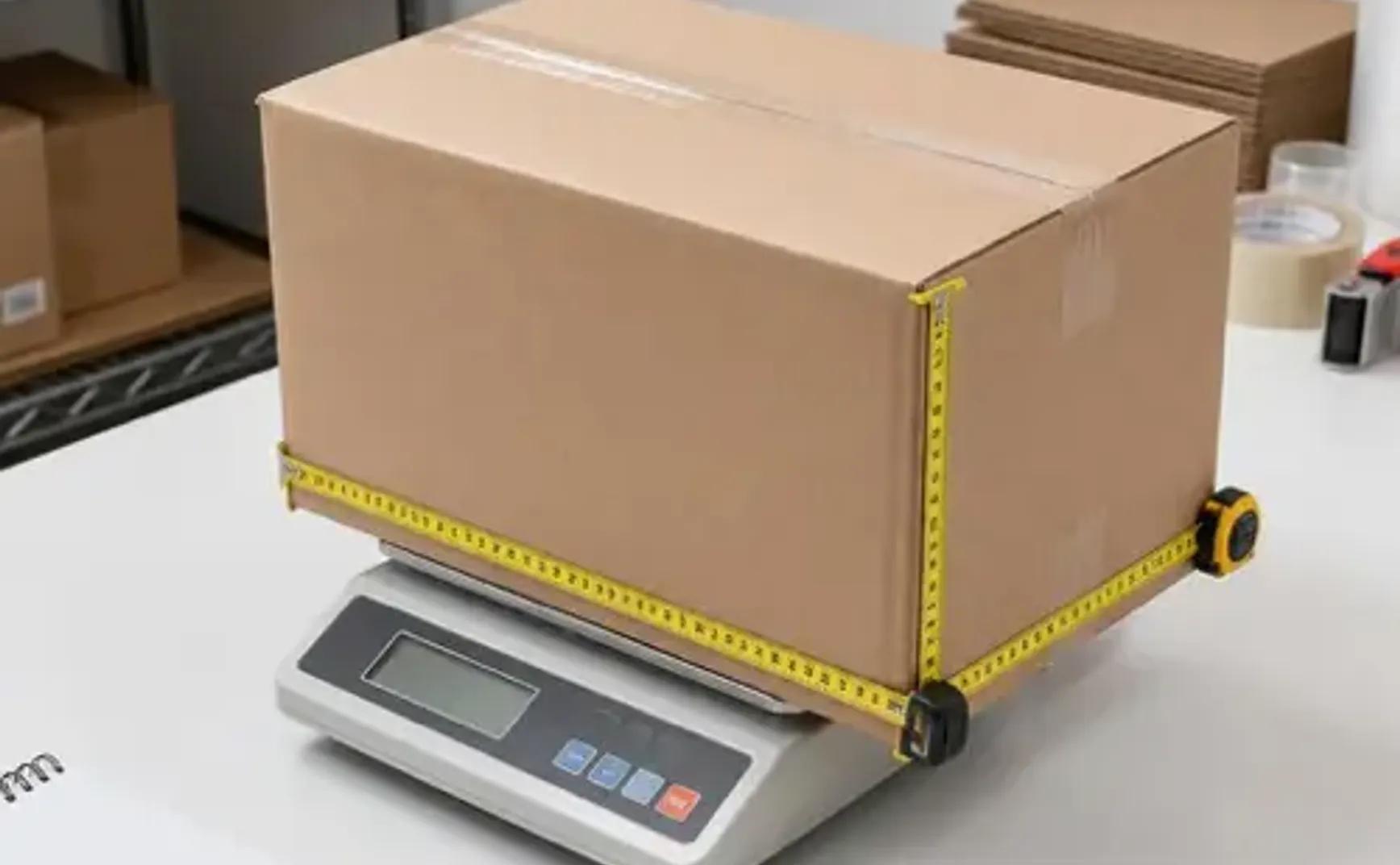
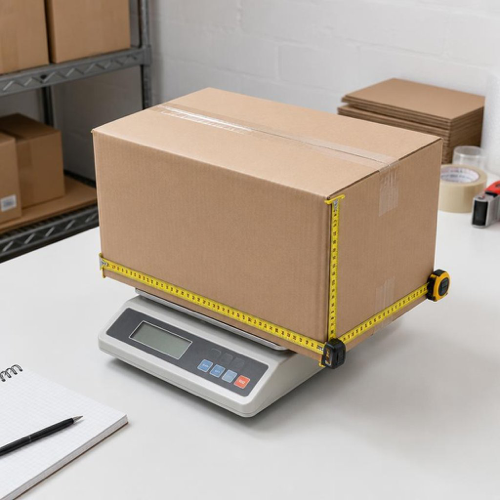
Illustration: international shipping calculations use both package weight and the dimensions of the finished parcel.
Your Taobao order has reached the Cainiao warehouse, and an international shipping estimate finally appears in the app. The amount is higher than expected. How can shipping cost so much when the products do not feel particularly heavy?
The answer often lies in three terms that are easy to confuse: scale weight, dimensional weight, and billable weight.
Once you understand them, you can estimate before ordering, check warehouse data after intake, choose packing options more deliberately, and understand what you are paying for before checkout.
What Are Scale Weight, Dimensional Weight, and Billable Weight?
Scale Weight: What the Finished Package Weighs on a Scale
Scale weight includes the products and the packing materials that remain in the shipment. Two boxes can occupy the same amount of space while weighing very different amounts. Metal products, for example, are usually heavier than clothing in a similarly sized box.
Dimensional Weight: Package Space Converted Into Weight
Aircraft, containers, and delivery vehicles have limited space. A large, lightweight box can occupy substantial capacity even when it is not heavy on a scale. Shipping systems therefore convert package volume into a weight value.
The common structure is:
Dimensional weight = length × width × height ÷ dimensional divisor
Dimensions are commonly entered in centimeters and the result expressed in kilograms. However, the divisor is not a universal constant. It can vary by route, transport mode, and service rule. Do not assume that a number quoted in an old post is the permanent rule for the current Cainiao U.S. route.
Billable Weight: The Weight Used to Price the Shipment
Billable weight is not necessarily the scale weight, and it is not always simply the dimensional weight. The service applies the route's comparison and rounding rules.
For example, if a checkout rule bills in 0.5kg increments, 6.1kg may become 6.5kg. The actual increment and method must be confirmed on the current route shown in your account.
The useful question is not only, “How heavy is my product?” Ask:
What are the scale weight, dimensional weight, and final billable weight for this package?
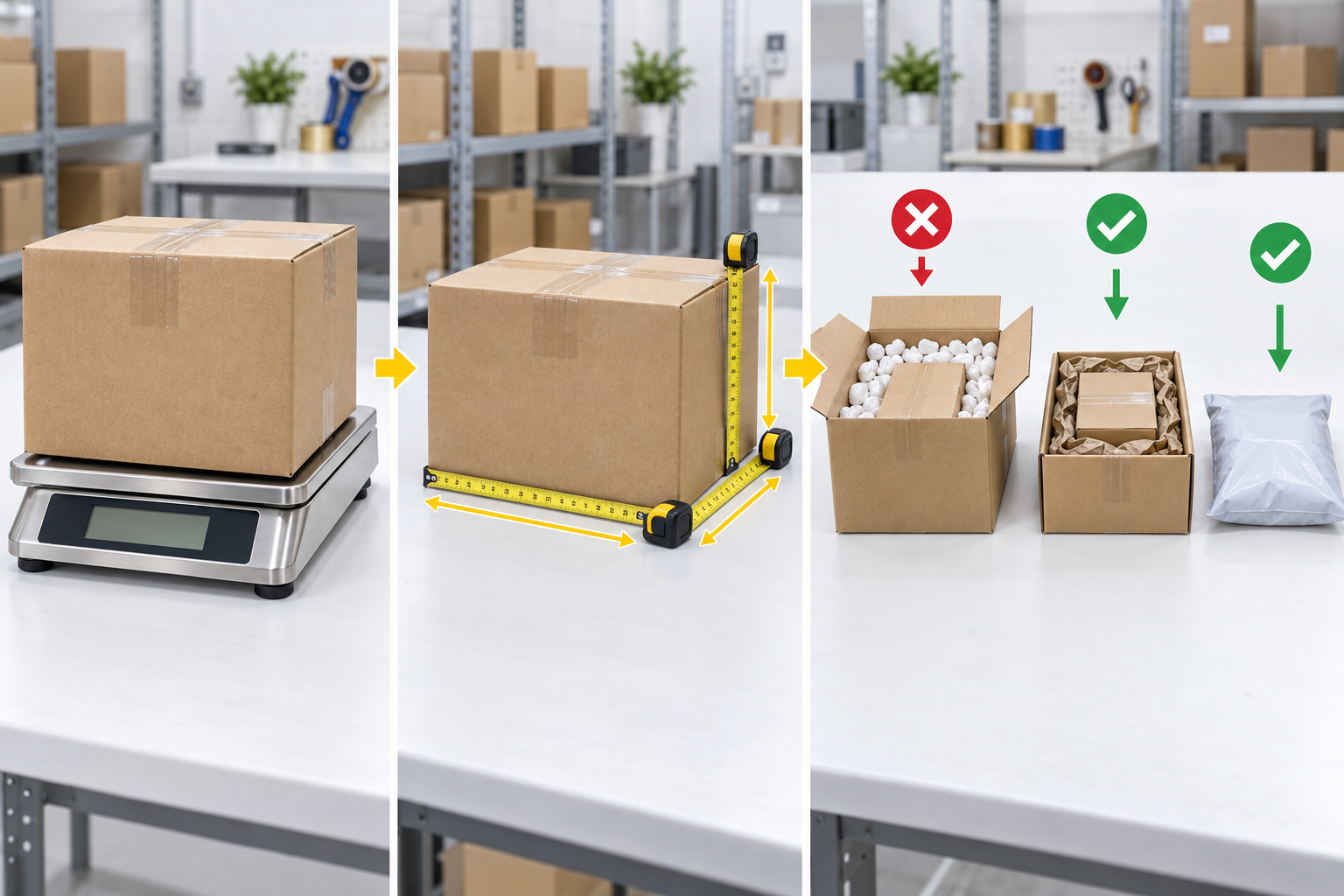
Illustration: confirm scale weight and all three dimensions, then keep necessary protection while avoiding unused space.
Why Can a Lightweight Product Be Expensive to Ship?
The classic example is a bulky, low-density product, such as:
- plush toys and pillows;
- storage bins and hollow plastic goods;
- shoe boxes, gift boxes, and display packaging;
- lampshades, decorations, and products that cannot be compressed;
- packages with multiple cartons, foam inserts, or air cushions.
Suppose an outer carton measures 50 × 40 × 30cm. Its volume is 60,000 cubic centimeters. The divisor used to convert that volume depends on the current route. A smaller divisor produces a higher dimensional weight.
That is why the seller's original package, a consolidated carton, and the final outbound package can produce different estimates for the same product.
How to Make an Initial Estimate Before Ordering
Ask the Taobao seller for two things:
- packed length, width, and height;
- packed gross weight, not only the product's net weight.
Enter those values in the Cainiao package and price calculator. If the seller does not yet have a weight, dimensions alone can still reveal whether the product is likely to be billed heavily for space.
Use the calculator to screen purchases, not as a final promise. Its result is for reference. The warehouse record, selected route, and checkout page determine the shipment you can actually purchase.
How to Review Warehouse Dimensions and Weight
After intake, do not rush to pay. Check:
- whether the warehouse photo shows the correct products and quantity;
- whether length, width, and height are reasonably consistent with the seller's information;
- whether the weight may include several products or additional packing;
- whether you are reading the correct units, such as centimeters, kilograms, or grams;
- whether the parcel has an oversized outer carton or excessive filler;
- whether the screen shows an intake estimate or the final post-consolidation data.
If a measurement looks clearly unreasonable, contact official support before payment. Keep the seller's packing information and the warehouse screen for comparison.
Does Consolidation Always Save Money?
Consolidation reorganizes several domestic packages into one international shipment. It can reduce duplicate cartons and repeated handling, but it is not automatically cheaper in every case.
It is more likely to help when:
- several clothing or fabric products can be compressed;
- small packages each arrive with separate courier bags or boxes;
- the products fit together without leaving large empty spaces;
- retail display boxes do not need to be preserved.
Use more caution when:
- fragile items require additional protection;
- products have very different shapes and leave empty space when combined;
- long, oversized, or unusual shapes may exceed route limits;
- certain products should not share a carton;
- removing packaging would increase damage or warranty risk.
How to Choose Among Packing Options
Remove Product Packaging
This removes product boxes and outer courier packaging where possible. It has the greatest potential to reduce volume for clothing, soft goods, and everyday products that do not depend on the original box for protection or value.
Remove Courier Packaging Only
This removes domestic delivery bags or cartons while preserving the product's retail packaging. It suits products that still need organized accessories, instructions, or moderate protection.
Keep All Packaging
This is appropriate for fragile products, collectibles, warranty needs, or resale. It may cost more, but reducing volume is not worth sacrificing essential protection.
Do not ask only, “How much shipping can I save?” Also ask, “How much could I lose if the product is damaged?”
Complete Four Checks Before Payment
1. Confirm the Packages
Make sure the consolidation includes the correct items, with no missing package and no parcel you intended to hold for later.
2. Confirm the Billing Data
Review scale weight, dimensional weight, billable weight, and billing increment. If the screen does not explain the rule, ask official support about the current route.
3. Confirm the Shipping Method
Compare the current price, estimated time window, product restrictions, and size or weight limits for each available route. The cheapest line on the screen is not automatically the best fit.
4. Confirm the Final Amount
For shipping to the United States, enter the Cainiao U.S. promo code USAVE. Pay only after checkout shows that the code applied and the amount due decreased. Eligibility and savings depend on the current checkout page.
How to Think About Three Common Product Types
Small, Light Products: Remove Repeated Packing
Phone cases, stationery, and small accessories are individually light, but orders from several sellers can arrive in separate courier bags. Consolidation may remove duplicate packing, although the final outer carton still matters.
Bulky Products: Dimensions Matter More Than Net Weight
For plush goods, pillows, and storage products, obtain packed dimensions first. Compressibility and removable boxes can matter more than the product's scale weight.
Small Appliances: Balance Weight, Volume, and Protection
Small appliances have meaningful scale weight and often require foam and a carton. Do not remove critical protection merely to reduce volume. Before ordering, also verify voltage, plug type, dimensions, and the actual rating label so you do not pay international shipping for an unsuitable product.
Remember This One Principle
International shipping prices a finished transport unit, not only the product sitting on a scale.
Estimate from packed dimensions and gross weight before ordering. Check warehouse data after intake. Balance space and protection during consolidation. Confirm billable weight and the current route before payment. Even when the final amount differs from your first estimate, you will understand why and still have a chance to choose.
Open Cainiao, review your package data, and use the Cainiao U.S. promo code USAVE at checkout
Note: Dimensional divisors, billing increments, routes, packing services, promotions, and final prices can change. Rely on the current Cainiao app and confirmation from official support.